

workflow and orchestration
AIBI-Studio The Orchestration Layer
Dec
Developing & Deploying Zero-Code AI Workflows with Flexibility & Control
The gap between “wanting AI” and “using AI” is usually filled with code.
Endless lines of Python.
Complex API integrations.
Weeks of debugging.
For a developer, this is a heavy lift.
For a business owner, it is a roadblock.
For an enterprise, it is a governance nightmare.
You are often stuck with a binary choice:
Buy a rigid, off-the-shelf AI tool that doesn’t fit your process.
Or build everything from scratch, costing you months and millions.
But there is a third way.
It is called the Orchestration Layer.
At AIBI-Studio, we believe the future belongs to those who can direct AI, not just those who can code it.
Here is how we use the Orchestration Layer to deliver Zero-Code AI workflows that give you the ultimate flexibility and control.
The Brain Behind the Operation
AI models, like GPT-4 or DeepSeek, are powerful, but they are raw.
They are like engines without a steering wheel.
To make them useful for business, you need a system to guide them.
You need a “Control / Orchestration” center.
This layer sits between your business data and the AI Models.
It handles the heavy lifting:
- Routing: Deciding which AI model is best for the task.
- Context: Feeding the AI the right history and data.
- Action: Converting the AI’s text answer into a real-world action, like sending an email or booking a cab.
Zero-Code: The “Magic” Interface
The most powerful feature of the Orchestration Layer is accessibility.
We realized that the people who understand the business process, the Operation Managers and Team Leaders, are rarely the ones writing the code.
So, we built Zero Code Module Development.
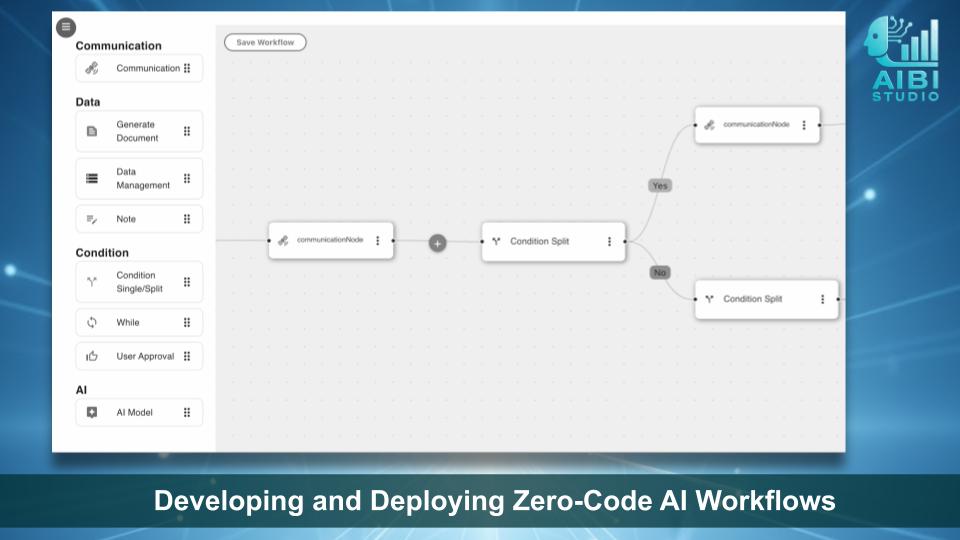
This allows you to map your exact process without writing a single line of code.
Instead of programming, you use:
- Workflow Builders: Visual tools to define “If this, then that” logic.
- Magic Connectors: Pre-built adaptors that plug into your existing files and software.
- No-Code Interfaces: Simple dashboards to configure rules, users, and alerts.
You keep using your same sheets and software, they just become 10x smarter.
Flexibility: Not All AI Is Equal
A rigid system forces you to use one AI model for everything.
A flexible Orchestration Layer gives you a Multi Provider Proxy.
This means you can mix and match:
- Generative AI: For writing customer emails or summaries.
- Internal Models: Smaller, faster models hosted securely for specific tasks.
- External Giants: Tapping into OpenAI, Deepseek, or Google Gemini for complex reasoning.
- Shared/Tuned Models: Utilizing models trained specifically for the Smart Group ecosystem.
The Orchestrator decides on the fly.
If a query is simple, it uses a cheap, fast internal model.
If it is complex, it routes it to a powerful LLM.
This ensures you aren’t burning budget on simple tasks.
Control: The Enterprise Guardrails
“Zero Code” often scares IT Directors.
They hear “Shadow IT.” They fear security leaks.
This is where the Orchestration Layer shines for the Enterprise.
It wraps the AI in a layer of Governance and Security.
Even though the workflow is easy to build, the backend is locked down:
- Guardrails: Rules that prevent the AI from saying or doing unsafe things.
- RBAC (Role-Based Access Control): Ensuring only authorized users can change workflows or view sensitive data.
- Audit Trails: A “Sentinel Monitoring” system that logs every single decision the AI makes for compliance.
- Data Privacy: A “Security & DLP Overlay” that redacts personal information (PI) before the AI ever sees it.
You get the speed of a startup with the security of a bank.
From Chatbot to Agentic Workflow
The ultimate goal of the Orchestration Layer is to move beyond simple chat.We move from “Predictive AI” (which guesses what might happen) to “Agentic AI”. An Agentic workflow does not just talk; it acts.
Imagine a Billing Agent workflow built on this layer:
- Trigger: A new invoice is uploaded.
- Think: The Orchestrator sends the image to a Vision Model to extract data.
- Verify: It checks the configuration to match the PO number.
- Act: If it matches, it triggers a payment via the API Gateway. If not, it alerts a human.
This is the power of orchestration: Thinks $\rightarrow$ Plans $\rightarrow$ Acts $\rightarrow$ Learns.
The AIBI-Studio Difference: Incubated for Excellence
Building an Orchestration Layer from scratch takes years. Leveraging one that is already battle-tested takes weeks. AIBI-Studio is the “Intelligence Engine” designed to make this accessible. We are proud to be incubated under Smart Group Incubations (SGI). This means our platform isn’t just a concept. It is built on the secure, scalable foundations of the Smart Group ecosystem, inheriting the same technology that powers massive logistical and compliance operations for global giants.
We combine the agility of a design studio with the robustness of an enterprise incubator.
Whether you are a developer looking to save time, or a business owner looking to save money, the Orchestration Layer is your bridge to the future.
Let’s Turn Your Business Intelligent Together.
